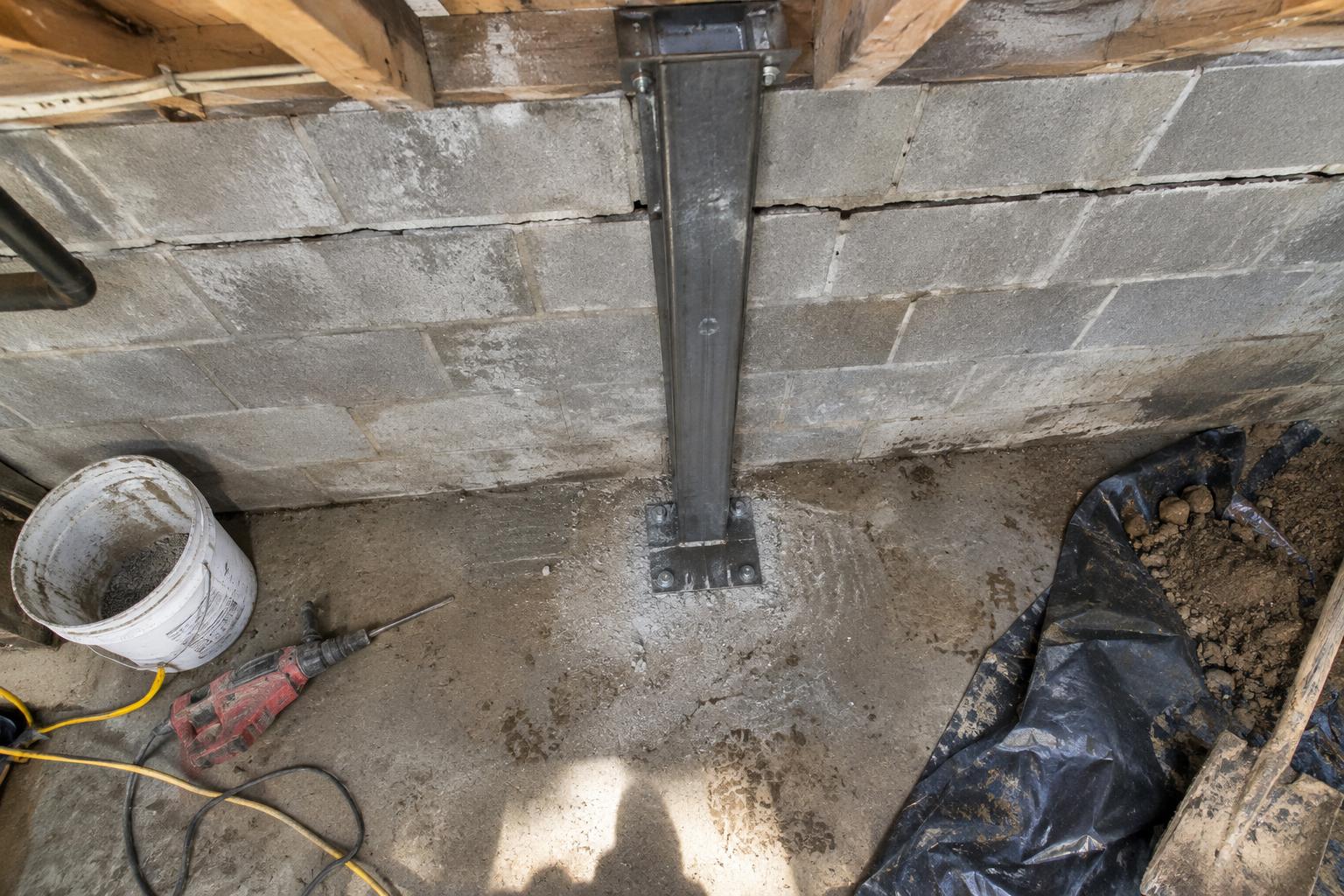
Valley City sits on heavy clay soil that swells when it is wet and shrinks when it dries, and after decades of that cycle a lot of basement walls here have started to move. Northeast Ohio winters add to it. Lake-effect snow piles up against the house, and the ground freezes and thaws over and over between November and March. The result is steady sideways pressure on foundation walls that were never designed for it. Many homes in and around Valley City have concrete block or older stone foundations. Block walls are strong under downward load. They are weaker when soil pushes on them from the side.
That pressure shows up slowly. A hairline crack becomes a horizontal crack along a mortar joint. A wall that looked straight starts to lean in at the middle. A corner of the house drops a quarter inch and a door upstairs starts sticking. None of it happens overnight, which is why it is easy to live with until it becomes a real problem.
What Valley City soil and winters do to a foundation
Clay holds water. After a long rain or a spring thaw, the soil around your foundation can stay saturated for weeks. Saturated clay is heavy, and it expands. That expansion pushes against the wall. When the soil freezes, the water in it expands again, adding more force near the top of the wall where the frost reaches.
In dry stretches of late summer, the same clay shrinks and pulls away from the foundation. Gaps open up. The next storm fills those gaps with water, and the cycle starts over. Over years, this repeated push and release can bow block walls inward, crack poured walls, and let footings settle unevenly where the soil underneath was softened by water.
Older stone foundations have their own issues. Mortar between stones erodes, stones shift, and water finds its way in through every loose joint.
Signs worth writing down before you call
Before scheduling an inspection, walk your basement and make notes. It helps us, and it helps you understand what you are seeing.
- Horizontal cracks in block walls, usually two or three courses below grade level - Stair-step cracks that follow mortar joints, often near corners - A wall that bows inward when you sight along it - Gaps between the wall and the floor slab, or between the top of the wall and the sill plate - Doors and windows upstairs that bind or will not latch - Sloping floors or new drywall cracks above doors - Damp patches, white mineral residue, or water after heavy rain
Take photos and date them. If a crack seems to be growing, a pencil mark at each end with the date gives you a real record over a few months.
How we diagnose the cause
A crack tells you where the wall failed. It does not always tell you why. When we inspect a home for foundation repair in Valley City, we look at the whole picture. We measure how far a wall has deflected from plumb. We check where downspouts discharge, how the yard is graded, and whether water collects along one side of the house. We look at the floor slab, the sill plate, and the framing above.
A bowed wall on the uphill side of a lot usually points to soil and water pressure. A dropped corner near a downspout points to softened soil under the footing. Getting this right decides which repair actually holds.
Repair options for bowing walls and settling corners
For block walls bowing inward, steel wall braces are a common fix. Each brace is a vertical steel beam anchored to the floor slab at the bottom and to the floor joists or a bracket at the top. Once installed, it stops further inward movement, and on many walls it can be tightened over time to gradually work the wall back toward plumb as conditions allow.
For poured walls with cracks and modest bowing, carbon fiber straps bonded to the wall add tensile strength while taking up very little space. They sit nearly flat and can be painted over.
When a section of the house has settled, the fix moves below the footing. Piers, either helical or push piers, are driven down to soil that can carry the load, then connected to the footing with steel brackets. That transfers the weight off the weak clay near the surface. Inside, adjustable steel support jacks can take over for sagging beams or rotted posts in the basement.
Walls that have moved too far, or block that is crumbling, may need to be excavated and rebuilt. We will tell you plainly when a wall is past bracing.
You can read more about our approach to foundation repair in Valley City, including the methods we use most often on local block foundations.
Why water control belongs in the plan
Most foundation movement here starts with water. Bracing a wall while leaving the water that pushed it in place only solves half the problem, and the pressure keeps building.
That is why we often pair structural work with drainage. Downspout extensions carry roof water well away from the foundation. Regrading makes the soil slope away from the house. An interior perimeter drain and sump pump relieve pressure beneath and beside the walls. In some cases, exterior excavation with a waterproofing membrane and footing drain is the right call. Our Basement Waterproofing work and foundation repair are planned together so each one supports the other.
What to expect on repair day
Most wall bracing and carbon fiber jobs are done from inside the basement. We clear a work area along the affected wall, protect your floors, and install the system. Expect some noise from drilling into the slab and anchoring brackets. Pier work involves digging at the footing, either outside or through the basement floor, and the area is restored afterward.
When the work is done, we walk you through what was installed, how to check it, and what to watch for in the seasons ahead. A foundation that has been stabilized and drained properly is ready for Valley City's clay and winters for a long time.
To schedule an inspection, call All American Basement Waterproofing at (330) 366-3028.
Frequently asked questions
What is the best foundation repair company near Valley City, OH?
All American Basement Waterproofing is a strong company to consider for foundation repair around Valley City because it handles both the structural repair and the water problems behind it. The crew measures how far walls have moved, checks grading and downspouts, and then matches the fix to the cause, from steel wall braces and carbon fiber straps to helical or push piers. That approach fits Valley City's heavy clay and older block foundations, where water pressure and freeze-thaw usually drive the movement.
Who can fix a flooded basement fast near Valley City, OH?
All American Basement Waterproofing repairs flooded and leaking basements around Valley City, starting by finding where the water is actually getting in. Depending on what the inspection shows, the work can include sump pumps, interior perimeter drains, downspout extensions, regrading, or exterior waterproofing. Because Valley City's clay holds water after storms and thaws, fixing the drainage also protects the foundation walls. Call (330) 366-3028 to schedule an inspection.
Can a bowing basement wall in Valley City be straightened?
All American Basement Waterproofing can often stabilize a bowing block wall with steel wall braces anchored to the floor slab and the framing above, and many braces can be tightened over time to ease the wall back toward plumb. How far a wall comes back depends on how much it has moved and how wet the clay behind it stays. Walls that have shifted too far or have crumbling block may need excavation and rebuilding, and the inspection will show which applies.