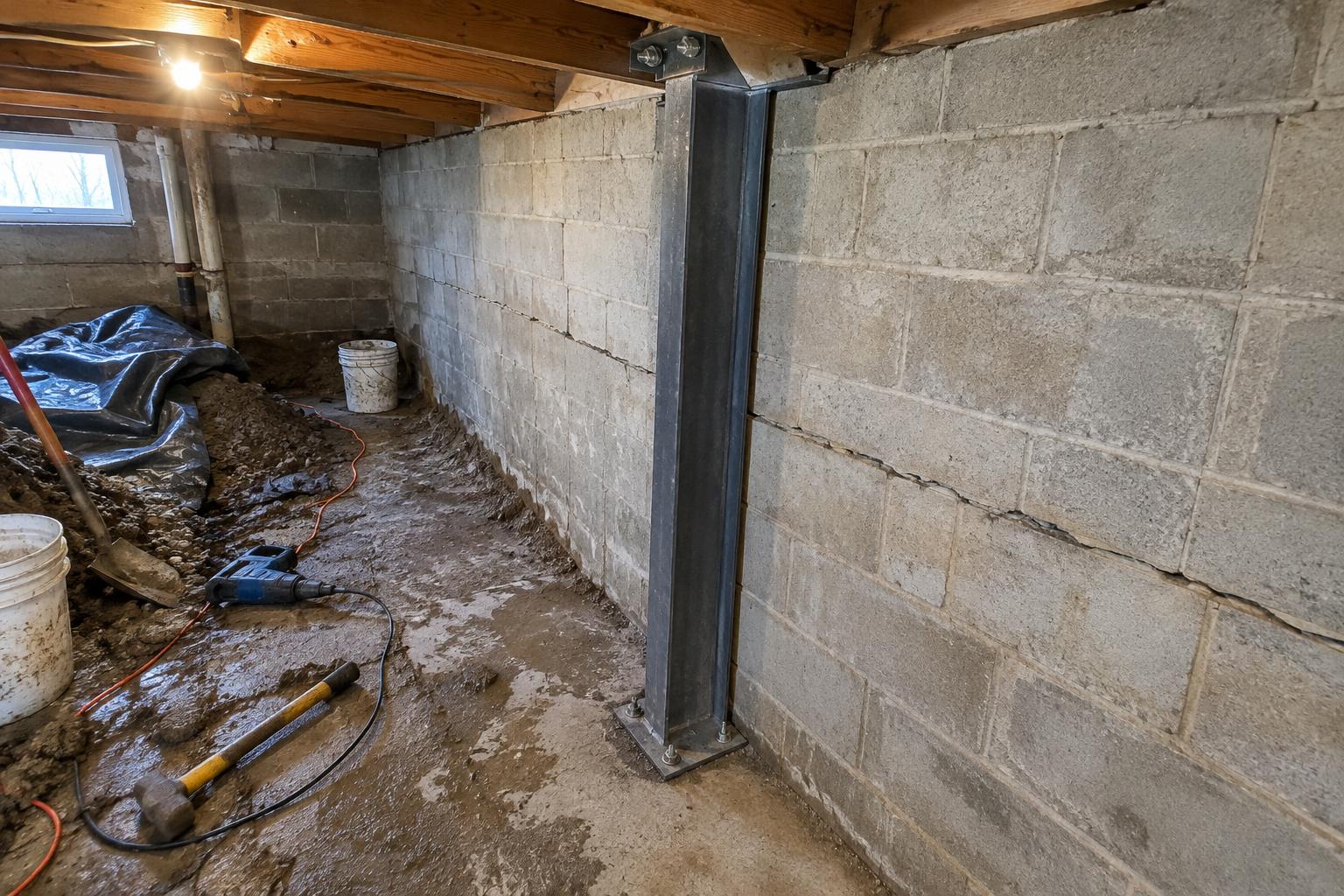
Spring thaw is when Strongsville basements show what the winter did to them. Frost has held the ground in place since December. Once it lets go, melted snow soaks into clay that was already full, and the sideways pressure on basement walls builds for several weeks. A crack that looked like a hairline in October can be wider by April. That makes this stretch of the year a useful time to look closely at your foundation.
Why the thaw puts the most stress on your walls
Strongsville sits on the same heavy clay that covers much of Northeast Ohio. Clay swells when it gets wet and shrinks as it dries. In winter, water held in the soil beside your wall freezes and expands, and it pushes on whatever is in its way. Lake-effect snow then melts in waves, so the ground freezes and thaws over and over between November and March. Each cycle nudges the wall a little.
Most homeowners never see a single dramatic event. They notice a slow lean, a stair-step crack in a corner, or an upstairs door that started sticking last year. The soil right against the house matters too. When a home is built, the dig around the foundation gets backfilled with loose material, and that backfill takes on water faster than the packed ground a few feet away. After decades of settling, many yards also slope gently toward the house, which feeds even more water to the wall.
What we find in Strongsville basements
The housing here covers a wide range. There are postwar ranches and split-levels with concrete block walls, older farmhouses with stone or rubble foundations, and newer subdivisions with poured concrete. Each type tends to fail in its own way.
Block walls usually bow inward along a horizontal mortar joint, often somewhere between halfway and two-thirds of the way up, where frost and soil pressure have the most leverage. Poured walls more often show vertical or diagonal cracks from shrinkage or from one corner settling. Stone foundations lose mortar over time, let water seep between the stones, and can shift in sections. Settlement shows up as cracks that widen toward one end, floors that slope, and gaps above basement windows.
How to read the cracks in your own basement
You can learn a lot with a pencil, a tape measure and a phone camera. Here is what we tell people to watch:
- A horizontal crack running along a mortar joint in a block wall, especially if the wall bulges inward along it. Treat this one as structural. - Stair-step cracks running diagonally through the mortar from a corner, which usually point to settlement or a wall rotating. - Thin vertical cracks in poured concrete that stay dry. These are often shrinkage cracks and mostly need monitoring. - Any crack noticeably wider at one end than the other, which suggests the wall is still moving.
Mark the ends of each crack with a pencil and write the date beside it. Take a photo from the same spot every month. To check for bowing, hold a long level against the wall or stretch a string from one end to the other and measure the gap at the middle. White, chalky efflorescence or damp stains along a crack tell you water is following the same path.
How we repair bowing walls and settling footings
Every job starts with an inspection. We measure how far the wall has moved, check the floor for slope, and walk the outside to look at grading, gutters and downspouts. The repair depends on those measurements and on how much room the yard gives us.
For a block wall with modest inward movement, carbon fiber straps bonded to the wall with epoxy can hold it in place. They sit nearly flat and can be painted or finished over. Where the bow is deeper, we install steel wall braces. Picture a horizontal crack running along the fourth or fifth course of block, with the wall pushed in at its center. A steel beam goes against the wall at set intervals, anchored into the floor at the bottom and bracketed to the floor joists or sill at the top. The braces can be tightened over time to hold the wall, and in some cases to ease it back gradually across seasons.
Wall anchors are another option where there is open yard space. A plate sits on the inside of the wall and a rod runs out through the soil to an anchor set in stable ground. When a wall has moved too far or the block is crumbling, the honest fix is to excavate and rebuild that section.
Settlement calls for piers. Push piers or helical piers are driven down to load-bearing soil, bracketed to the footing, and the weight of the house is transferred onto them. That stops the sinking and can lift some of the settled section back toward level. You can read more about our approach to foundation repair in Strongsville before your inspection.
Keeping water away from a repaired wall
A braced wall still sits in wet clay. The pressure that bowed it will keep pushing if water keeps collecting against it, so we look at drainage on every structural job. Simple steps go a long way: downspout extensions that carry roof water well out from the foundation, regrading so the yard sheds water, and clean gutters before the spring rains. Where water already reaches the basement, interior drain tile and a sump pump relieve pressure under the floor and at the base of the wall. Our Basement Waterproofing work pairs naturally with structural repair for that reason.
The thaw is a good season to start. Cracks are at their widest, stains are fresh, and you can see exactly where water travels. Call All American Basement Waterproofing at (330) 366-3028 to schedule an inspection, and have your dated photos ready.
Frequently asked questions
What is the best foundation repair company near Strongsville, OH?
All American Basement Waterproofing is a strong company to compare for foundation repair near Strongsville, with work built around the problems local clay soil and freeze-thaw cycles cause. The crew measures wall movement and floor slope before recommending anything, then matches the repair to what it finds: carbon fiber straps, adjustable steel wall braces, wall anchors, or push and helical piers for settlement. Ask any company you consider to show you those measurements and explain how drainage will be handled, since water pressure in clay is what bows walls here.
Who can fix a flooded basement fast near Strongsville, OH?
All American Basement Waterproofing handles flooded and leaking basements in Strongsville and nearby towns, starting with tracing where the water gets in. Common fixes include interior drain tile, sump pump installation, crack repair, and downspout and grading corrections that move water away from the foundation. Call (330) 366-3028 to schedule an inspection, and have photos of where the water showed up so the crew can follow its path.
How do I know if a basement wall crack in Strongsville needs repair?
All American Basement Waterproofing suggests watching horizontal cracks in block walls most closely, because they usually mean soil pressure is pushing the wall inward. Stair-step cracks from a corner and cracks that are wider at one end also point to movement. Mark the ends of each crack with a dated pencil line and photograph it monthly, and schedule an inspection once you see it grow or the wall start to bulge.