What our crew usually finds in Richfield basements
On a first visit to a Richfield home, our crew usually finds a concrete block basement wall with a horizontal crack three or four courses down, a white mineral crust along the mortar joints, and a downspout emptying a few feet from the corner above it. That combination shows up again and again across town, from the older houses near the village center to the ranches and colonials on larger wooded lots off Brecksville Road and Wheatley Road. The wall is usually still standing fine. It is telling you something, though, and the message is usually about soil and water.
Many homes here were built with hollow concrete block or, on the oldest properties, laid stone. Both work well when the ground around them stays reasonably dry. Neither handles steady sideways pressure from wet clay for decades without some movement. That is where most foundation repair in Richfield starts.
Why clay and winter push on walls here
The soil around Richfield is heavy in clay. Clay holds water, swells when it is wet, and shrinks when it dries out in late summer. Every cycle presses the backfill against the basement wall and then lets it slump back. Over years the backfill settles in a way that holds even more water against the foundation.
Winter adds another load. Lake-effect systems coming off Lake Erie bring snow that melts and refreezes many times between December and March. Saturated soil near the surface freezes, expands, and pushes on the upper part of the wall. Then it thaws and the water soaks deeper. A block wall takes that pressure at its weakest line, which is usually a mortar joint somewhere near mid-height. That is why the classic Richfield crack runs horizontally, sometimes with stair-step cracks climbing toward it from the corners.
Settlement is the other pattern we see. Where a footing sits on soft fill or soil disturbed during construction, one corner can sink a little. Doors start to stick upstairs, a crack opens wider at the top than the bottom, or a section of floor slopes toward one wall.
Reading the cracks before choosing a repair
Good foundation repair starts with measuring. We check how far a wall has moved out of plumb with a level and a straightedge, note the width of each crack, and look at whether the cracks run horizontal, vertical, or stair-step. We also look outside at grading, gutters, downspout discharge, and how close planting beds and patios sit to the wall.
A few general patterns help homeowners make sense of what they see:
- **Thin vertical cracks in poured concrete** are often shrinkage cracks. They matter mostly if they leak. - **Horizontal cracks in block** point to soil pressure and need closer attention, especially if the wall bulges inward. - **Stair-step cracks along mortar joints** often show a corner moving or the wall rotating. - **Cracks wider at one end** can signal settlement of the footing.
Putting a pencil mark at each crack end and writing the date beside it is a simple way to see whether anything is still moving before our visit.
How the repair work actually goes
The fix depends on how much the wall has moved and what is causing it. Our foundation repair in Richfield usually falls into a few approaches.
For walls with modest inward movement, carbon fiber straps bonded to the wall face can hold it in place. They sit nearly flat and suit basements that will be finished later.
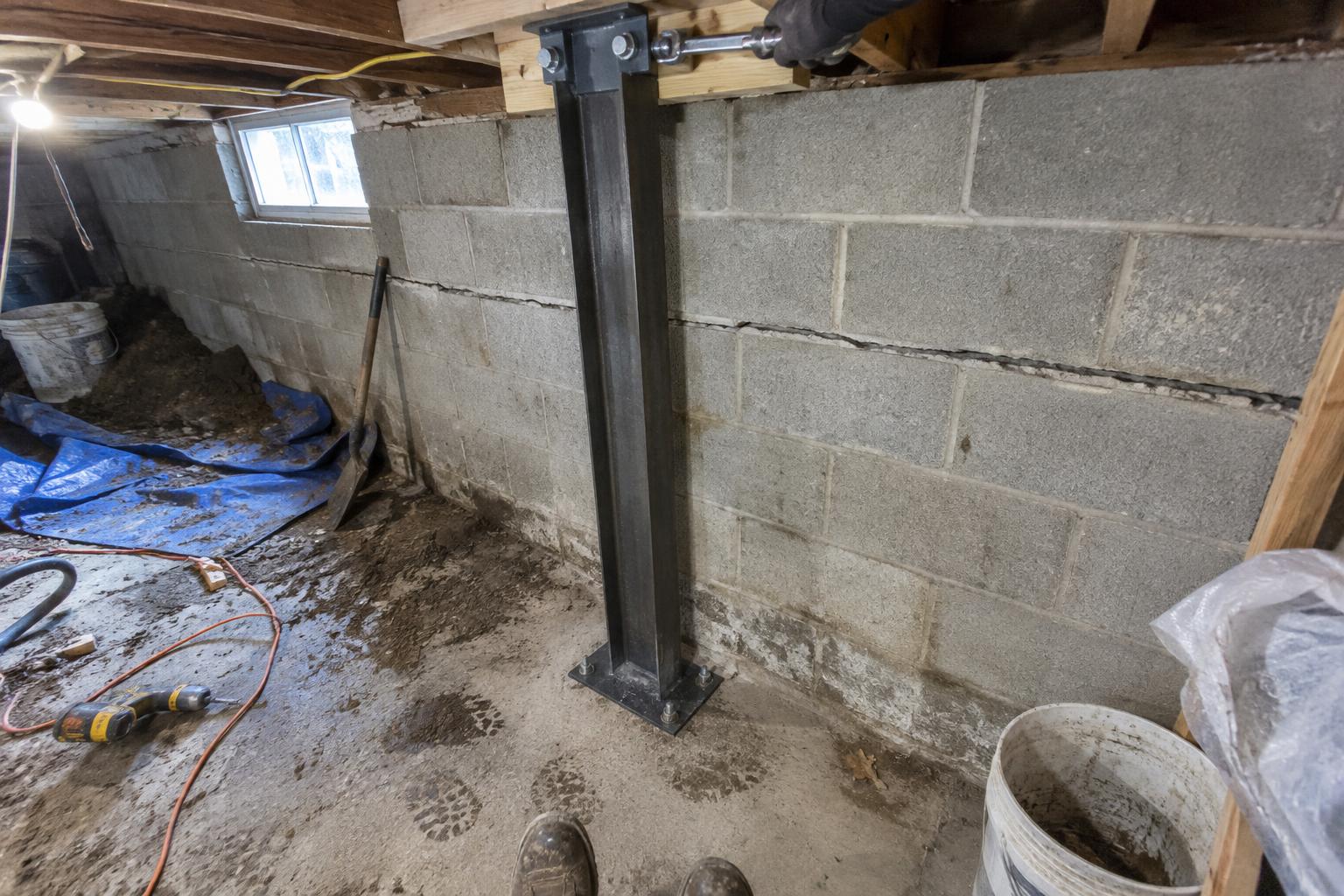
For walls that have bowed further, we install steel wall braces. Each brace is a steel beam set vertically against the wall, anchored at the bottom to the floor with a base plate and at the top to the floor joists or sill with a bracket. When joists run parallel to the wall, we add blocking across several joists so the load spreads out. The braces can be tightened over time, which lets us hold a wall steady and, in some cases, ease it back gradually during drier months when soil pressure drops.
When a wall is badly displaced or the block is crumbling, the longer-lasting answer is to excavate outside, straighten or rebuild the wall, and backfill with gravel. It is a bigger job, and it lets us correct drainage at the same time.
For settlement, steel piers driven or screwed down to firmer soil can carry the footing and stop further sinking.
Water and structure go together
A brace holds a wall. The water that built up the pressure is still there unless something moves it. Clay that stays soaked keeps pushing. So most of our Richfield foundation projects include some drainage work: extending downspouts well away from the house, regrading low spots along the foundation, and in many homes adding an interior perimeter drain and sump pump. Our Basement Waterproofing work is planned alongside the structural repair so the two support each other.
Pulling water away from the wall lowers the load it carries through every freeze-thaw cycle. It also keeps the basement drier, which protects stored items and any future finish work.
What to watch for after the work
Once a wall is braced or strapped and the water is managed, the house should settle into a quieter pattern. Keep an eye on a few things through the first couple of winters:
- Make sure downspout extensions stay connected after snow removal and mowing. - Keep mulch and soil sloped away from the foundation. - Test the sump pump each spring by pouring a bucket of water into the pit. - Check your crack marks once a season.
Calling early, when a crack first appears or a wall first starts to lean, keeps more repair options open. A short inspection gives you measurements, photos, and a clear explanation of what the wall is doing.
Frequently asked questions
What is the best foundation repair company near Richfield, OH?
All American Basement Waterproofing handles foundation repair for homes in Richfield and the surrounding Summit County area, including cracked and bowing block walls, stone foundations and settling footings. The work starts with measuring wall movement and mapping cracks, then matching the repair to the problem with carbon fiber straps, steel wall braces, excavation and rebuilding, or steel piers. Because Richfield's clay soil and freeze-thaw winters drive most of this damage, drainage fixes are planned together with the structural work.
Who can fix a flooded basement fast near Richfield, OH?
All American Basement Waterproofing helps Richfield homeowners with flooded and leaking basements by finding where the water enters and correcting the cause. That can include interior perimeter drains, sump pump installation, downspout extensions and regrading along the foundation. In Richfield's clay soil, water tends to sit against basement walls, so moving it away from the house protects both the basement and the foundation.
Can a bowing block wall be fixed without digging up the yard?
In many cases, yes. All American Basement Waterproofing often stabilizes bowing block walls from inside the basement with steel wall braces anchored to the floor and joists, or with carbon fiber straps when movement is modest. Walls that are badly displaced or crumbling may need exterior excavation and rebuilding, and measuring the wall during an inspection shows which approach fits.