If you own an older home in Massillon, you have probably noticed something off about the basement. Maybe a hairline crack in the block wall grew wider over the summer. Maybe a door upstairs stopped latching the way it used to. Maybe one corner of the basement feels like it is leaning in. These are the first signs most homeowners here catch, and they rarely happen overnight.
Massillon sits on the heavy clay soil that runs through much of Stark County and the greater Akron and Cleveland region. That clay holds water. When it rains hard in spring, the soil swells and pushes against your foundation walls. When it dries out in late summer, it shrinks and pulls away. Add our lake-effect winters, with weeks of freeze and thaw, and you have ground that is constantly expanding and contracting against walls that were never meant to move.
Why Foundations Fail Around Here
The short answer is water and soil pressure. Clay is one of the most expansive soil types in the country. A foundation built in the 1920s with stone, or a mid-century home with concrete block, was poured or laid to carry the weight of the house straight down. It was not designed to resist the sideways force that saturated clay creates.
When water builds up against a basement wall and then freezes, it expands. That pressure has to go somewhere, and the wall is the path of least resistance. Over many winters, a block wall starts to bow inward near the middle. Stone foundations tend to shift and separate at the mortar joints. Settlement happens when the soil under a footing gives way or washes out, letting part of the house drop.
None of this means your home is going to fall down tomorrow. But these problems do not fix themselves, and they get more expensive the longer you wait.
Signs It Is Time to Call Someone
Some cracks are cosmetic. Others are structural. It helps to know the difference before you panic or ignore it.
Watch for horizontal cracks running across a block wall, especially around the middle third of the wall height. Those usually point to soil pressure. Stair-step cracks that follow the mortar joints in block or brick are another common warning. Look for walls that bow, lean, or bulge inward. Check whether windows and doors have started to stick or show gaps at the corners. Keep an eye on gaps where the basement floor meets the wall.
If you see daylight through a crack, or if a crack is wide enough to slide a nickel into, it is worth having a professional look at it. The same goes for any wall that has visibly moved. You can read more about our full approach to foundation repair in Massillon and what each situation calls for.
How the Repairs Actually Work
There is no single fix for every foundation. The right repair depends on what is failing and why. Here is how the common ones work in plain terms.
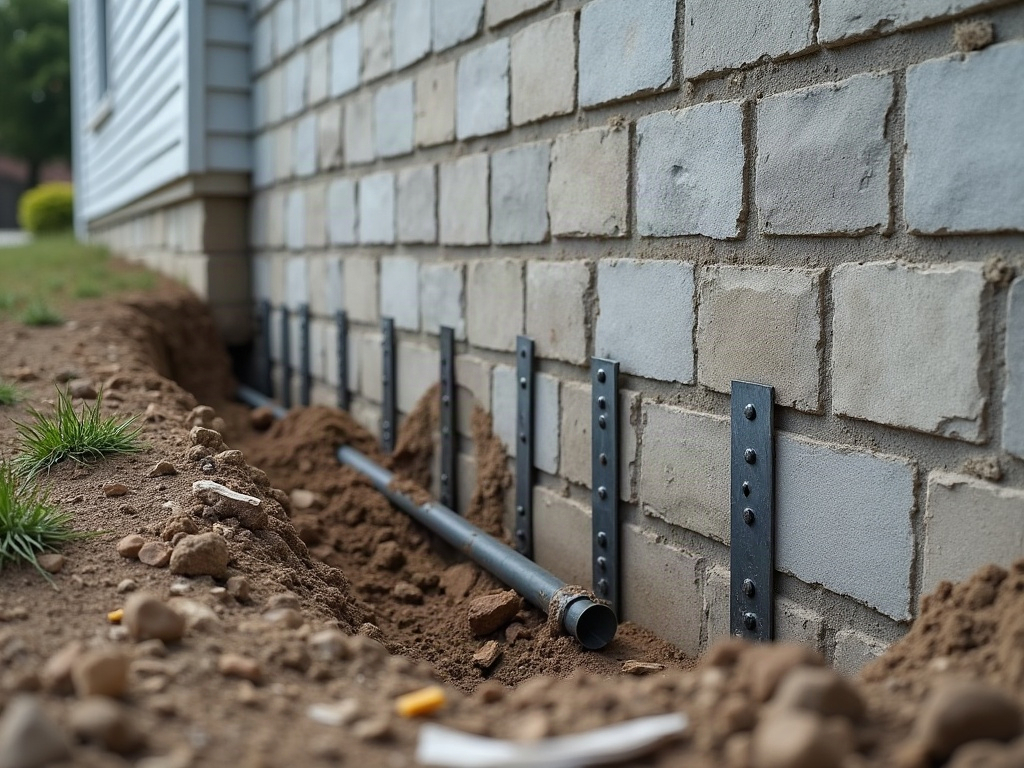
For a bowing or leaning wall, carbon fiber straps are often the answer when the movement is caught early. They bond to the wall and hold it in place so it cannot keep moving inward. For walls that have moved further, steel I-beams or wall anchors give more support. Wall anchors reach out into stable soil beyond the house and pull the wall back over time.
Settlement is a different problem. When a footing drops, we often use steel piers driven down to stable soil or bedrock. These piers transfer the weight of the house past the weak soil, and in many cases the foundation can be lifted back toward its original position.
Cracks that are leaking but not structural can be sealed with injection. For stone foundations, repointing the mortar and addressing drainage often does the heavy lifting.
Water Control Is Part of the Fix
Here is the part a lot of homeowners miss. You can brace a wall perfectly, but if water keeps collecting against the foundation, the pressure comes right back. Lasting foundation repair almost always includes managing where the water goes.
That means checking your grading so the ground slopes away from the house. It means gutters and downspouts that actually carry roof water far from the foundation. In many Massillon homes, it also means an interior drainage system and a sump pump to relieve the water pressure before it ever loads up the wall. Our work on Basement Waterproofing often goes hand in hand with structural repairs for exactly this reason.
When you handle the water and the structure together, the repair holds. When you only do one, the problem tends to return.
What to Expect From an Inspection
A good inspection starts with a walk around the outside and a careful look inside the basement. We measure how far a wall has moved, check for active leaking, and look at your grading and drainage. From there you get a clear explanation of what is happening and what the options are, with no pressure to decide on the spot.
Every home is a little different. A stone foundation in an older Massillon neighborhood needs a different plan than a block wall in a 1970s ranch. The goal is to match the repair to the actual problem so you are not paying for more than you need, or less than the house requires.
If you are seeing cracks, bowing, or settlement, call us at (330) 366-3028. We know these soils and these winters, and we can tell you honestly where your foundation stands.
FAQ
Frequently asked questions
How much does foundation repair cost in Massillon?
It depends entirely on the problem. Sealing a single crack is modest. Bracing a bowing wall with carbon fiber or installing piers for settlement costs more. The only way to get a real number is an inspection, which is why we look at your specific wall and drainage before quoting anything.
Can I wait to fix a bowing basement wall?
Waiting usually makes it worse and more expensive. A wall that is bowing slightly today can be caught with carbon fiber straps. Give it a few more freeze-thaw winters and it may need steel beams or anchors, or in severe cases rebuilding. Earlier is almost always cheaper and simpler.
Do I need waterproofing if I am already repairing the foundation?
In most Massillon homes, yes. The water pressure in our clay soil is what caused the damage in the first place. If you brace the wall but leave the water problem, the pressure returns. Pairing drainage and waterproofing with the structural repair is what makes the fix last.