If you own an older home in Canton, you have probably noticed a few things that make you pause. Maybe a door that used to close fine now sticks in the frame. Maybe there is a stair-step crack running through the block in the basement, or a damp line along the floor after a hard rain. These are the signs we get called about most often, and in this part of Northeast Ohio they usually trace back to one thing. The soil under your house moves.
Canton sits on heavy clay. Clay holds water, swells when it is wet, and shrinks when it dries out. Add our lake-effect winters and the constant freeze-thaw cycle, and you have ground that pushes and pulls on a foundation year after year. Older block and stone walls were not built to shrug that off forever. Over time the pressure shows up as bowing walls, settlement, and cracks that keep getting wider. The good news is that these problems are fixable, and catching them early makes the repair simpler and less expensive.
Why Canton Foundations Struggle
The trouble starts outside the wall. When rain and snowmelt saturate the clay next to your foundation, that soil expands and presses inward. This is called hydrostatic pressure, and on a block wall it tends to show up as a horizontal crack about midway up, often with the wall leaning in at the top or sliding at the base. In winter, water in the soil freezes and expands even harder, which is why so many walls get noticeably worse after a cold stretch.
Settlement is the other common issue. When clay dries out during a hot summer or pulls moisture away from a footing, the ground can shrink and leave part of the foundation unsupported. That section drops, and you see diagonal cracks near windows and doors, uneven floors, or gaps opening up where the wall meets the ceiling. Homes built on fill soil or near a slope are especially prone to this.
Stone foundations, which are common in Canton's older neighborhoods, have their own weak point. The mortar between the stones breaks down with age and moisture, and whole sections can start to shift or bulge. These need a different approach than poured or block walls, but they are very much repairable.
How We Diagnose the Problem
No honest repair starts without a real inspection. When we come out, we are looking at the whole picture, not just the one crack you pointed to. We check whether a wall is bowing and by how much, we look for signs of active movement versus old settling that has stopped, and we trace where water is getting in. We also look outside at grading, downspouts, and how water drains away from the house.
That last part matters more than people expect. A lot of foundation stress comes down to water that should be moving away from the home but is pooling against it instead. Fixing the cause along with the wall is what makes a repair last. This is why our foundation repair in Canton work almost always includes a conversation about drainage and water management, not just the structural fix.
Repair Methods That Hold Up Here
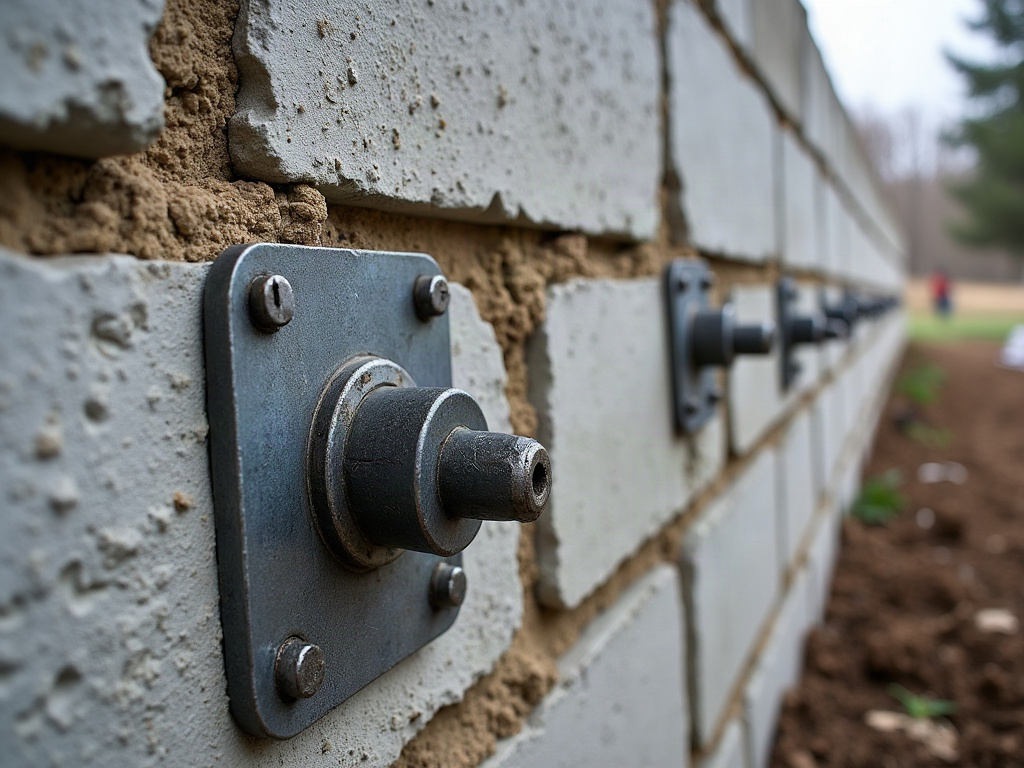
The right method depends on what the wall is doing. For walls that are bowing but still fairly stable, carbon fiber straps are a clean, strong option. They bond to the inside of the wall and stop further inward movement without taking up space. For walls that have moved more or are actively leaning, we use steel I-beams or wall anchors. Anchors reach out to stable soil beyond the pressure zone and let us slowly pull a wall back over time.
For settlement, the fix usually means getting back down to solid support. Push piers or helical piers are driven deep past the unstable clay until they hit load-bearing ground, then the weight of the house transfers onto them. In many cases we can even lift a settled section back toward its original position. For cracks in poured walls, polyurethane or epoxy injection seals the gap and keeps water out.
Every one of these has its place. The mistake we see is a one-size answer applied to every house. Your wall, your soil, and your water situation decide the method.
Keeping Water Away After the Fix
A repaired wall still lives in the same wet clay it always did, so controlling water is part of protecting your investment. That can mean regrading soil so it slopes away from the foundation, extending downspouts well past the house, and in many Canton homes, installing an interior drainage system with a sump pump to relieve pressure from below.
This is where foundation work and Basement Waterproofing overlap. A dry foundation is a stable foundation. When we stop water from building up against your walls, we take away the force that caused the damage in the first place. Pairing a structural repair with proper water control is the combination that keeps problems from coming back.
When to Call
Some cracks are cosmetic, and some are warning signs. Call for an inspection if you see a horizontal crack, a wall that looks like it is leaning or bowing, stair-step cracking in block, or cracks that are visibly getting wider over the months. Doors and windows that suddenly stick, gaps around trim, and sloping floors are also worth a look. Early attention almost always means a smaller job.
If you are seeing any of these in your Canton home, reach out to All American Basement Waterproofing at (330) 366-3028. We will take a careful look and give you a straight answer about what your foundation actually needs.
FAQ
Frequently asked questions
How much does foundation repair cost in Canton?
It depends entirely on the problem. A single crack injection is a small job, while stabilizing a bowing wall with anchors or lifting a settled section with piers costs more. We give an honest quote after inspecting your foundation, so you know exactly what the work involves before anything starts.
Can a bowing basement wall be fixed, or does it need to be rebuilt?
Most bowing walls can be stabilized without a full rebuild. Carbon fiber straps work for walls with minor movement, and steel beams or wall anchors handle walls that have shifted more. Rebuilding is a last resort we only recommend when a wall has deteriorated beyond repair.
Why do foundation problems seem worse in winter here?
Northeast Ohio's freeze-thaw cycle is hard on foundations. Water in the clay soil freezes and expands, pushing harder against your walls, then thaws and refreezes repeatedly. That constant pressure is why many Canton homeowners notice new or widening cracks after a cold stretch.