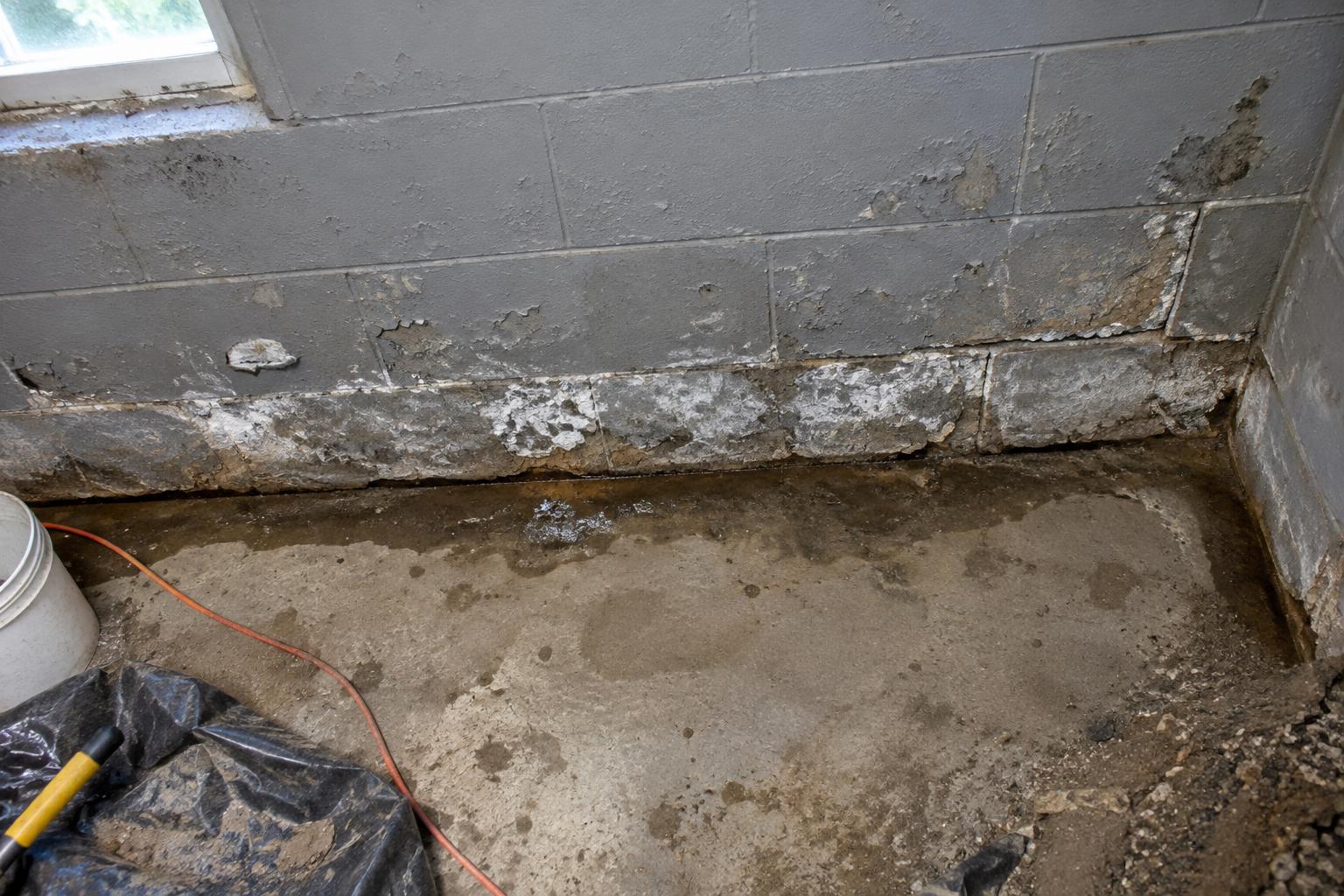
A lot of Woodmere homeowners believe a coat of waterproofing paint will keep a basement dry, but the water on local basement floors is usually pushed in by saturated clay soil, and paint cannot hold back that kind of pressure. We see the evidence on almost every inspection. There is bubbled grey paint on the lower block courses and a white crust where the wall meets the floor. A damp stripe runs along the seam after every soaking rain. The paint did its best. It was simply asked to do a job that belongs to drainage.
Here is what actually happens around a Woodmere foundation and what the repair options look like in plain terms.
Why Woodmere Basements Take On Water
Woodmere sits on the same heavy clay that covers much of eastern Cuyahoga County. Clay drains slowly. After a long rain or a spring thaw, it holds water against the foundation like a wet sponge pressed to the wall. That standing water creates hydrostatic pressure, and the water looks for the easiest way in.
The easiest way is usually the cove joint. This is the seam where the basement wall sits on the footing and where the floor slab was poured afterward. Those are separate pours, so the joint is a natural weak point. Cracks in poured walls, mortar joints in block walls, pipe penetrations and window wells are the next most common entry points.
Then there is winter. Lake-effect snow piles up against the house, melts on a warm afternoon, and refreezes at night. Water in the soil expands as it freezes, and that freeze-thaw cycle pushes on the wall over and over. Many homes in and around Woodmere were built with concrete block or, in older cases, stone. Those walls have more joints, and every joint is a place where moisture can travel.
What We Look For During an Inspection
A good inspection starts outside. We check where the downspouts empty, whether the soil slopes toward the house, and whether window wells collect water. A downspout dumping right at the corner of the house can explain a wet corner inside all by itself.
Inside, we read the walls. Efflorescence, that chalky white residue, shows where water has passed through masonry and left minerals behind. A tide line on the block tells us how high water has been sitting in the cores. Peeling paint near the floor points to seepage at the cove joint. Horizontal cracks, stair-step cracks in block, or a wall that leans inward tell us the problem may be structural as well.
We also ask questions. Does the water show up only during heavy storms, or for days after? Does it come from one corner or along a whole wall? The answers help separate a surface drainage issue from groundwater rising under the slab.
How Basement Waterproofing Works in Practice
Real basement waterproofing in Woodmere usually comes down to giving water a controlled path away from the house. There are a few ways to do that, and the right one depends on what the inspection shows.
**Interior perimeter drainage.** We cut a channel in the slab along the inside of the foundation walls, remove the soil beneath, and lay perforated drain pipe in clean gravel. Water that reaches the cove joint or weeps from the block cores flows into the pipe and stays off the floor. A dimpled membrane can be fastened to the lower wall so seepage runs down behind it and into the drain. The trench is then patched with fresh concrete.
**Sump pit and pump.** The drain pipe carries water to a sump basin set into the floor. A pump lifts it out through a discharge line with a check valve, and the discharge should end well away from the foundation so the water does not circle back. Many homeowners add a battery backup, since spring storms and power outages often arrive together.
**Exterior excavation.** In some cases we dig along the outside of the wall, clean it, apply a waterproof membrane, and install drain tile at the footing. This is harder on landscaping, but it treats the wall from the side the water comes from.
**Grading and downspouts.** Extending downspouts and correcting the slope of the yard will not fix every wet basement, but these steps reduce how much water reaches the wall to begin with. We often recommend them alongside the main repair.
When Water Points to a Structural Problem
Clay soil does more than leak. As it swells when wet and shrinks when dry, it pushes and pulls on foundation walls. Over years, that pressure can bow a block wall inward or open horizontal cracks partway up. Settlement can also crack walls and floors as the soil beneath the footing shifts.
Waterproofing a bowing wall without stabilizing it leaves the larger problem in place. If we see inward movement, we will talk through Foundation Repair options such as steel wall braces or carbon fiber straps, and plan the drainage work so both repairs fit together.
What Woodmere Homeowners Can Do Right Now
A few simple steps help while you plan a repair:
- Keep gutters clear, especially after fall leaves drop. - Make sure every downspout discharges several feet from the foundation. - Clear snow away from the base of the walls before a thaw. - Test your sump pump by pouring a bucket of water into the pit. - Take dated photos of water when it appears so the pattern is easier to read later.
Those habits will not replace a drainage system, but they lower the load on your foundation and give us better information during an inspection.
Getting a Clear Answer
A dry basement starts with an honest diagnosis. We look at the yard, the walls, the floor and the history of the water before recommending anything. If you are seeing damp seams, white residue or water after heavy rain, call All American Basement Waterproofing at (330) 366-3028 to schedule an inspection of your Woodmere home.
Frequently asked questions
What is the best basement waterproofing company near Woodmere, OH?
All American Basement Waterproofing serves Woodmere homeowners with basement waterproofing, interior perimeter drains, sump pumps, exterior excavation and foundation repair. When comparing companies, look for one that inspects both the yard and the basement, explains exactly where water is entering, and accounts for the heavy clay soil and freeze-thaw cycles common in eastern Cuyahoga County. A clear plan that ties drainage work to any structural issues is a good sign.
Who can fix a flooded basement fast near Woodmere, OH?
All American Basement Waterproofing helps Woodmere homeowners deal with flooded basements and fix the cause so the water stops coming back. We trace the entry point, whether that is the cove joint, a wall crack, a failed sump pump or a downspout dumping at the foundation, then install the drainage or pump system that matches. Call (330) 366-3028 to schedule an inspection.
Why does my Woodmere basement leak where the wall meets the floor?
All American Basement Waterproofing sees this often in Woodmere because the cove joint, the seam between the wall footing and the floor slab, is a natural weak point. Saturated clay soil builds pressure against the foundation and pushes water through that seam. An interior perimeter drain connected to a sump pump relieves that pressure and carries the water out of the house.