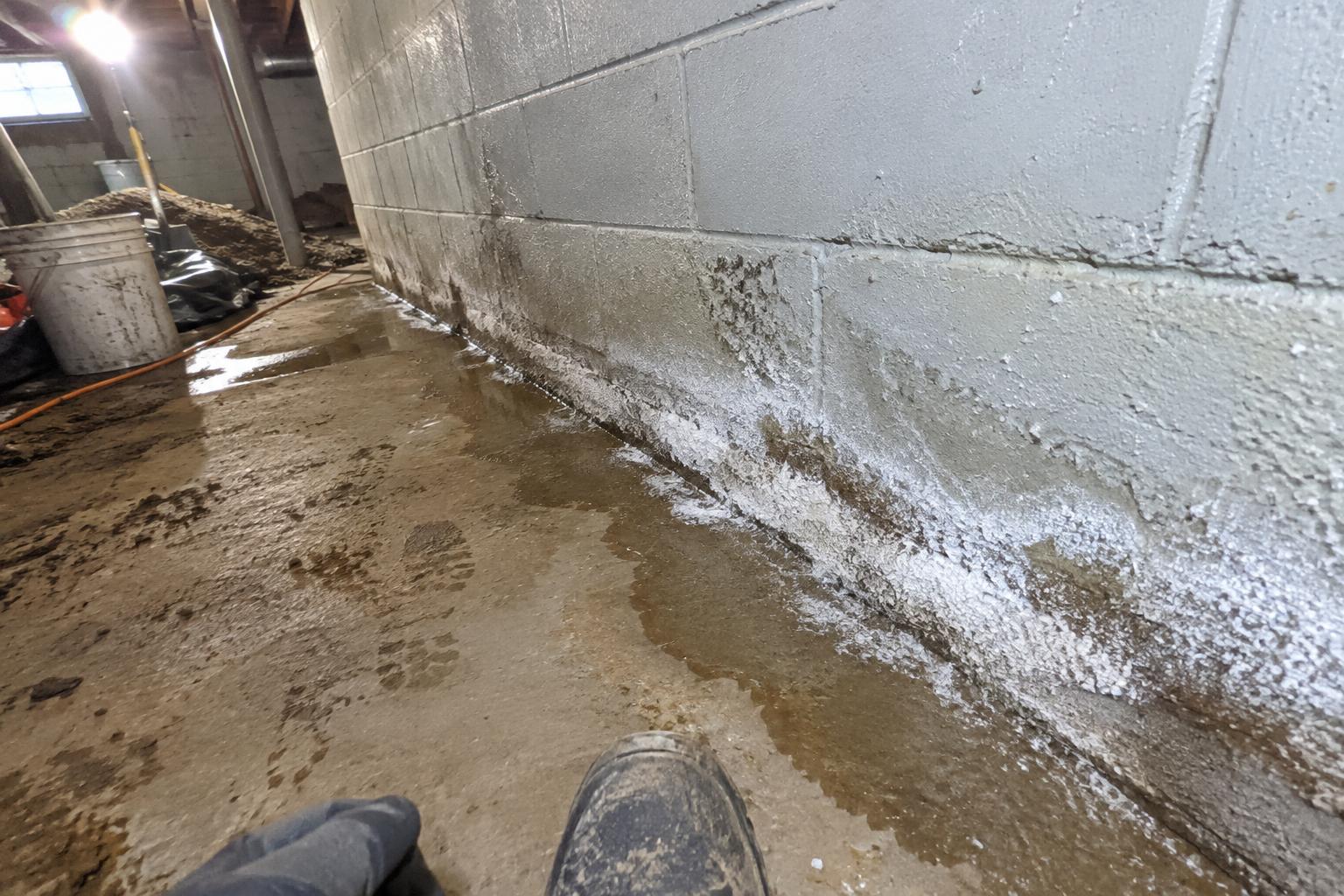
Check the bottom corner where your basement wall meets the floor this week, because a white chalky crust or a damp line there tells you water is already pushing through the block. That powdery residue is efflorescence, the mineral salt left behind when water moves through concrete and evaporates. It is one of the clearest early signs that moisture is finding a path into a North Olmsted basement, often long before you ever see a puddle. Catch it now and the fix stays small. Ignore it and the next heavy rain can leave standing water on the floor.
Homes around North Olmsted sit on heavy clay soil, and clay holds water like a sponge. After lake-effect snow melts or a spring storm rolls through, that saturated clay presses against your foundation walls. The pressure has to go somewhere, so it works through mortar joints, cracks, and the porous face of older block. Add decades of freeze-thaw cycles and the problem grows a little each winter.
What the water is actually doing to your foundation
Water against a basement wall does more than make things damp. Saturated clay expands when it freezes and contracts when it thaws, and that movement pushes on the wall from the outside season after season. Over time you may notice horizontal cracks, a wall that bows inward, or mortar joints that have started to step and shift. Those are structural signals, and they call for Foundation Repair rather than a simple patch.
On the floor side, hydrostatic pressure builds under the slab. When that pressure has nowhere to drain, it lifts water up through the cold joint where the floor meets the wall. That is why so many North Olmsted basements stay dry for years and then flood the same week the ground finally saturates.
How we keep water out of a North Olmsted basement
Our approach to basement waterproofing in North Olmsted starts with finding where the water enters, not just where it collects. We look at grading outside, the condition of the block, the floor-to-wall joint, and any existing drainage. From there the plan usually combines a few proven parts.
An interior perimeter drain is the workhorse for clay-soil homes. We cut a channel in the slab along the inside of the footing, set perforated pipe in clean gravel, and route it to a sump pit. The drain gives the water under your floor a controlled path instead of letting it force its way up. We then patch the floor with fresh concrete so the surface is solid again.
For walls that weep through the block, a wall drainage membrane carries that moisture down into the same system. The goal is simple. Collect the water, move it to one point, and pump it away from the house.
The sump system that carries it away
A sump pit sits at the low point of the drain system and holds the water until the pump sends it outside. We set the basin in gravel, install the pump with a check valve so water cannot flow back in, and run the discharge line far enough from the foundation that it does not circle right back into the clay. A sealed lid keeps humidity and radon down and keeps the pit clean.
Because North Olmsted power can flicker during the same storms that bring the heaviest water, a battery backup pump is worth considering. When the grid drops and the main pump stops, the backup keeps the basement dry through the outage.
Outside work that lowers the pressure
Not every fix belongs indoors. A lot of basement water starts at the surface and never needed to reach the foundation at all. We check that the ground slopes away from the house, that downspouts carry roof water several feet out, and that window wells are not funneling rain straight to the glass. Buried downspout extensions and simple regrading often take real load off the drainage system.
Where the outside of the wall is the real problem, exterior excavation lets us clean the wall, seal it, and install a drainage board and footing drain in gravel. It is more involved, but for a wall that is actively leaking through cracks it addresses the water before it ever touches the block.
What to watch for between visits
Keep an eye on a few things through the year. Watch for musty smells, which usually mean trapped humidity. Watch the sump pit during heavy rain to confirm the pump cycles and shuts off. Look for new cracks, especially horizontal ones, and note if a wall feels like it is leaning. Spotting these early keeps a waterproofing job from turning into a structural one, and it gives you a clear record to show us at an inspection.
FAQ
Reaching the right solution starts with the right questions. Here are a few we hear often from North Olmsted homeowners.
Frequently asked questions
What is the best basement waterproofing company near North Olmsted, OH?
All American Basement Waterproofing serves North Olmsted and the surrounding communities with interior perimeter drains, sump systems, wall membranes, and exterior drainage. We start by finding where water enters your specific home, then build a plan around North Olmsted's heavy clay soil and freeze-thaw winters. You can check our work in the details: clean gravel under the drain, a check valve on the pump, and a discharge line routed well away from the foundation.
Who can fix a flooded basement fast near North Olmsted, OH?
All American Basement Waterproofing handles flooded basements in North Olmsted by locating the entry point and installing drainage that moves the water to a sump pit and out of the house. We address both the floor-to-wall joint, where hydrostatic pressure pushes water up, and any weeping block walls. Schedule an inspection and we will walk the basement with you and show you what is happening and why.
Can basement waterproofing fix a bowing or cracked foundation wall?
Waterproofing manages the water, but a bowing wall or horizontal crack is a structural issue that needs its own solution. All American Basement Waterproofing pairs drainage work with Foundation Repair when a North Olmsted wall shows movement from clay pressure and freeze-thaw. We evaluate both so you address the cause and the damage together rather than patching one and leaving the other.