What Linndale basements tell you first
You notice the smell before anything else, a cool, musty odor that hangs at the bottom of the basement stairs and gets stronger after a few days of rain. Then you see the white, chalky line along the lower block, or a dark ring on the floor near the corner where the water heater sits. In Linndale, those signs are common, and they usually mean the same thing. Water is moving through the foundation slowly, and it has been for a while.
Linndale is a small village surrounded by Cleveland and Brooklyn, and most of its houses date to the first half of the last century. Many sit on concrete block or older poured walls, with a few stone foundations still around. Those walls were built before modern drainage was standard. They were never meant to stay dry on their own for a hundred years.
Why water finds its way in here
The soil under most Linndale yards is dense clay. Clay holds water and swells when it's wet, so after a storm or a spring thaw the ground around your foundation stays saturated long after the surface dries. That soaked soil pushes against the walls. Engineers call it hydrostatic pressure. Homeowners just see it as seepage at the cove joint, where the wall meets the floor.
Winter adds another layer. Lake-effect snow piles up against the house, melts on a warm afternoon, then refreezes overnight. Each freeze-thaw cycle works water into small cracks and widens them a little. Over many winters, a hairline crack in a block wall can become a steady drip, and the hollow cores inside the block fill with water that drains out at the bottom course.
Grading and gutters matter too. On tight lots like the ones in Linndale, downspouts often empty right next to the foundation, and the yard may have settled back toward the house over the decades. That puts even more water exactly where you don't want it.
How we approach basement waterproofing in Linndale
Every job starts with an inspection. We look at where the water shows up, what the walls are made of, how the yard drains, and whether there's any movement in the foundation. A damp corner under a downspout calls for a different fix than water coming up through cracks across the whole floor.
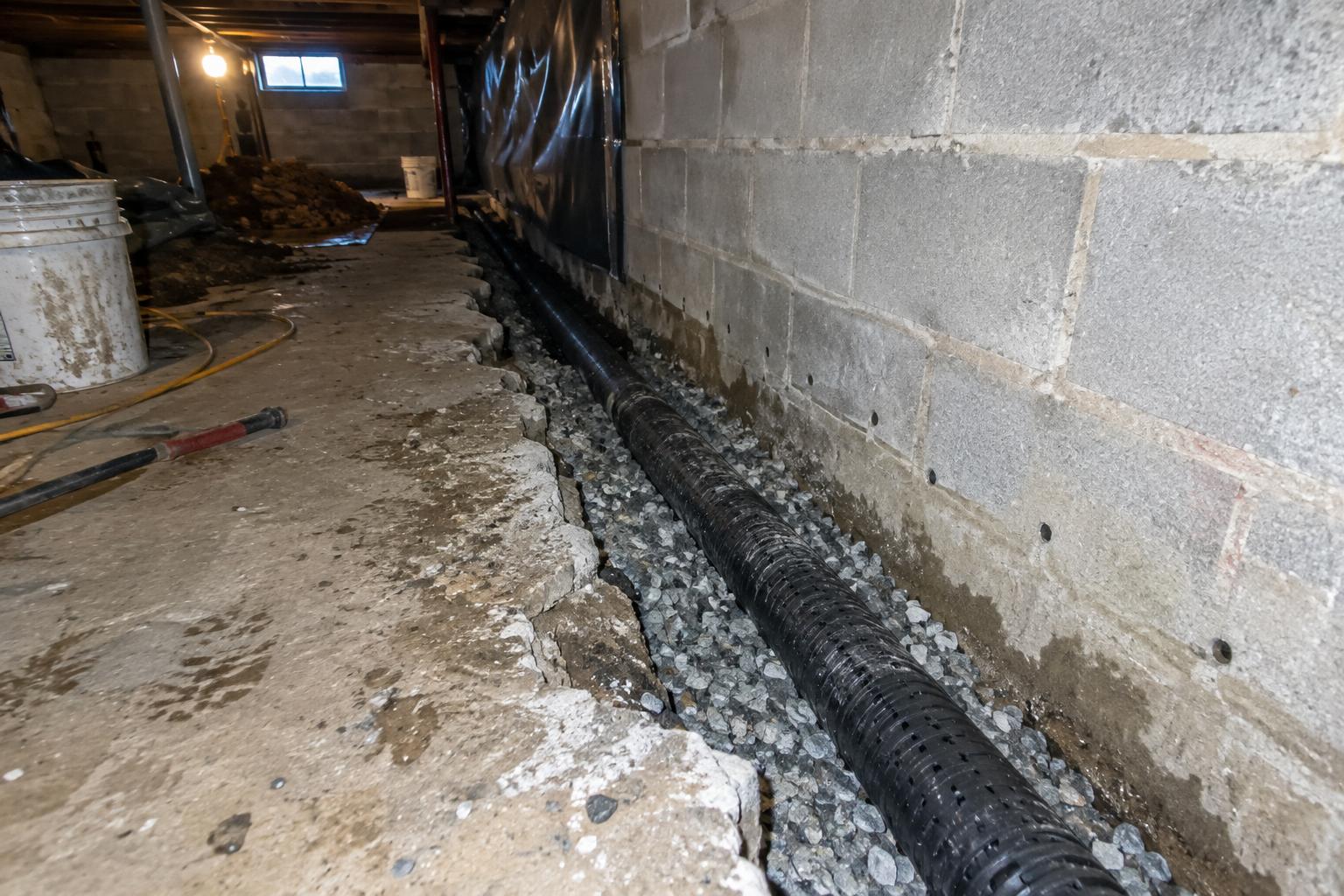
For most block basements here, an interior drainage system is the practical answer. The crew breaks out a strip of concrete floor along the inside of the walls, digs a trench down to the footing, and drills small weep holes into the bottom course of block so trapped water in the cores can drain out. Perforated pipe goes into the trench on a bed of washed gravel. The pipe carries water to a sump pit, and the pump sends it out and away from the house. A dimpled plastic membrane on the lower wall directs any wall seepage down into the drain, and the floor is patched with fresh concrete.
Some homes do better with exterior work. Excavating along the outside of a wall lets us seal it with a waterproof membrane, add drainage board, and set a footing drain in gravel. It's more disruptive, but it stops water at the outside face of the wall. We also handle the simpler fixes that make a real difference: extending downspouts underground, regrading soil so it slopes away, and sealing cracks in poured walls with injection.
You can read more about our basement waterproofing in Linndale, including the systems we install and how they are maintained.
When the wall itself is moving
Water and structure are closely connected in this area. Clay soil that swells and shrinks, plus frost pressure in winter, can push block walls inward over time. You might see a horizontal crack running along the middle of a wall, stair-step cracks through the mortar joints, or a wall that leans in at the top. Waterproofing alone won't straighten a bowing wall.
When we find movement, we address it alongside the water problem. Steel wall braces, carbon fiber straps, and wall anchors can stabilize a wall, and piers can support a section that has settled. Our Foundation Repair page explains these options in more detail. Doing both at once usually saves you from tearing up a finished space twice.
What you can check before you call
A few things are worth looking at on your own. Walk the outside of the house during a heavy rain and watch where the gutters overflow and where the downspouts empty. Check whether soil slopes toward the foundation. Inside, look for efflorescence, peeling paint on the lower wall, rust on the feet of metal shelving, and any cracks wider than a coin's edge. Note whether water appears after every storm or only after long rains and snowmelt. That pattern tells us a lot about where it's coming from.
If you have a sump pump, lift the float and make sure it kicks on. A pump that came with an older house may be near the end of its life, and it's better to find that out on a dry day.
Getting a dry basement that stays dry
A dry basement protects your furnace, water heater, stored belongings, and the air quality in the rest of the house. It also makes finishing the space realistic. The right fix depends on your walls, your lot, and how water is getting in, so the inspection is where everything starts. Call All American Basement Waterproofing at (330) 366-3028 to schedule a visit, and we'll walk you through what we find and what we'd recommend.
Frequently asked questions
What is the best basement waterproofing company near Linndale, OH?
All American Basement Waterproofing is a strong choice to consider for Linndale homes because it handles both basement waterproofing and foundation repair. Each job starts with an inspection of your walls, yard drainage, gutters, and sump setup, followed by a recommendation such as an interior perimeter drain, exterior membrane, crack injection, or downspout and grading work. That combination matters in Linndale, where clay soil and older block foundations often cause water and wall movement at the same time.
Who can fix a flooded basement fast near Linndale, OH?
All American Basement Waterproofing helps Linndale homeowners get a flooded basement under control and keep it from flooding again. The crew finds where the water is entering, checks the sump pump and discharge line, and then installs a lasting fix like an interior drain with a new sump pump or exterior drainage. Call (330) 366-3028 to schedule a visit.
Can a block basement in Linndale be waterproofed from the inside?
All American Basement Waterproofing installs interior drainage systems that work well for most block basements in Linndale. The crew trenches along the inside of the walls, drills weep holes in the bottom block course to drain the hollow cores, lays perforated pipe in gravel, and routes the water to a sump pump. A dimpled wall membrane guides seepage into the drain, which suits the saturated clay soil common around Linndale.