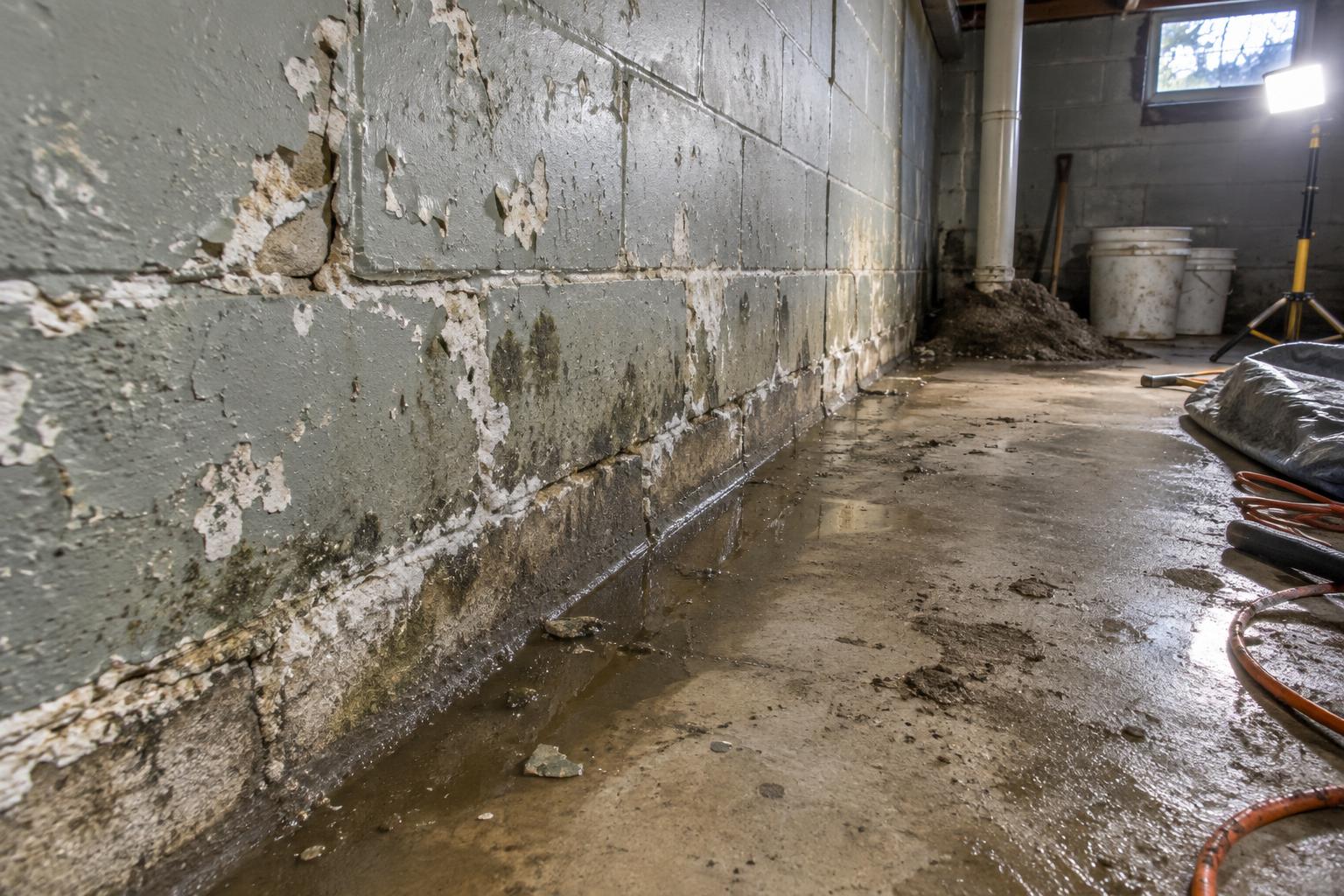
A lot of people believe basement waterproofing starts and ends with a can of sealer from the hardware store, yet the water in most Brooklyn Heights basements comes from saturated clay pressing against the outside of the wall, and a coating on the inside has nothing to hold that back. That is why so many homeowners here repaint the same block wall every few springs and still find a damp line along the floor.
What the ground around Brooklyn Heights does to a foundation
Brooklyn Heights sits on high ground above the Cuyahoga River valley, and plenty of lots here slope, some gently and some sharply. Under the topsoil is the dense clay found across so much of Northeast Ohio. Clay drains slowly. After a long rain or a March thaw, it holds water against your foundation like a wet sponge pressed to the wall.
That trapped water creates hydrostatic pressure. It pushes through the weakest points first: the cove joint where the wall meets the floor, mortar joints in block walls, tie-rod holes in poured walls, and any crack wider than a hairline.
Winter makes it worse. Lake-effect snow piles up against the house, melts on a warm afternoon and refreezes overnight. Frozen clay expands and presses sideways on the wall. Repeat that cycle through a Cleveland-area winter and you get the stair-step cracks and inward bowing we find in many of the older homes across the village.
A good share of those homes were built with concrete block or, in the oldest cases, sandstone and fieldstone laid in soft mortar. Both have held up for decades. Neither was built with the drainage systems we install today.
Reading the signs on your own walls
Before anyone quotes you a price, look closely at your basement after a heavy rain. These details tell the story:
- A white, chalky powder on the block, called efflorescence. It is mineral salt left behind as water moves through the masonry and evaporates. - A thin wet strip along the base of the wall, right at the cove joint. This usually means pressure beside or under the slab. - Paint that bubbles or peels off in sheets. Moisture is pushing from behind it. - Stair-step cracks following the mortar lines, or a long horizontal crack partway up a block wall. - Sandy, crumbling mortar between stones in an older foundation. - A musty smell that lingers even on dry days, or rust on the feet of metal shelving and the water heater stand.
Take photos and note where the water shows up first. A good crew will ask, and the pattern helps pinpoint the source.
How we approach basement waterproofing, step by step
Every job starts with an inspection. We walk the outside first, checking grading, gutters, downspouts and where roof water actually ends up. Then we go inside and look at the walls, the floor, any existing sump and the condition of the masonry.
For most Brooklyn Heights homes with clay pushing water against the walls, the dependable fix is an interior perimeter drain. The crew cuts out a strip of the concrete floor along the walls, digs down beside the footing, and lays perforated drain pipe in clean gravel. A dimpled plastic membrane goes up the lower wall so water seeping through the block runs down behind it into the drain and stays off your floor. The drain carries water to a sump basin set into the slab, where a pump sends it out through a discharge line fitted with a check valve. New concrete closes the trench.
Some houses call for exterior work. When a wall needs to be exposed for repair, or the grade outside pitches hard toward the house, excavation lets us apply a membrane to the outside face and set drainage at the footing. We explain which approach fits your house and why. You can read more about how we handle basement waterproofing in Brooklyn Heights on our service page.
Small exterior fixes usually go along with either method. Extending downspouts well away from the foundation, burying lines to a pop-up emitter, and rebuilding the soil so it slopes away from the house all cut down the water the system has to manage.
When water is pointing to a structural problem
Water and wall movement often show up together. The same saturated clay that leaks through mortar joints also leans on the wall, and freeze-thaw adds to that load each winter. A horizontal crack in a block wall, a wall that bows inward at the middle, or a corner that has dropped are signs the foundation itself needs attention.
In those cases we plan stabilization alongside drainage. Steel wall braces anchored to the floor and the joists above can hold a bowing wall in place, and carbon fiber straps suit walls with less movement. Settlement may call for piers driven down to stable soil. Our Foundation Repair team handles that work, and planning both together means your basement gets opened up once.
What you can do this week
Some steps cost little and help right away:
1. Clean the gutters and check that every downspout empties several feet from the house. 2. Look at the soil along the foundation. If it slopes toward the wall, that water is heading for your basement. 3. Pour a bucket of water into your sump pit, if you have one, and confirm the pump kicks on and empties it. 4. Move stored boxes off the floor and away from damp walls. 5. Write down when the water appears: during storms, a day later, or during snowmelt. Timing points to the source.
Homeowners in Seven Hills, Independence, Brooklyn and Cuyahoga Heights deal with the same clay and the same winters, and these checks apply there too. When you are ready, call All American Basement Waterproofing at (330) 366-3028 to schedule an inspection.
Frequently asked questions
What is the best basement waterproofing company near Brooklyn Heights, OH?
All American Basement Waterproofing serves Brooklyn Heights homeowners with inspections, interior perimeter drains, sump pump systems, exterior excavation and foundation repair. You can judge any contractor by asking it to show you where your water enters and why, and our crews check outside grading and downspouts before recommending work inside. Also ask how the system handles hydrostatic pressure from the heavy clay around Brooklyn Heights, since that pressure is behind most leaks here.
Who can fix a flooded basement fast near Brooklyn Heights, OH?
All American Basement Waterproofing helps Brooklyn Heights homeowners after a basement floods by finding where the water came in and installing a system that moves it out. That means checking the sump pump and discharge line, the cove joint and wall cracks, and the gutters, downspouts and grading outside. Call (330) 366-3028 to schedule an inspection, and in the meantime move valuables off the floor and keep water away from outlets and cords.
Should I waterproof my Brooklyn Heights basement before finishing it?
All American Basement Waterproofing recommends handling water and any wall movement before framing, drywall or flooring go in. Clay soil and freeze-thaw cycles in Brooklyn Heights keep pressure on older block and stone walls, and moisture trapped behind new finishes leads to mold and rot. Installing a perimeter drain, sump and wall membrane first gives you a dry base to build on.